Wife Charlotte Payne-Townshend
Queer Places:
Shaw's Corner, Bibbs Hall Ln, Welwyn AL6 9BX, United Kingdom
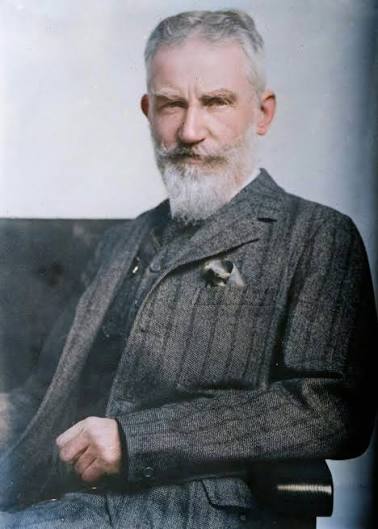 George Bernard Shaw (July 26, 1856 - November 2, 1950) was an iconic Irish playwright, polemicist, literary critic, and political activist. His extensive influence on
Western theater, culture, and politics spanned from the late 19th century until his death. He remains one of history's most prominent literary figures, famous for blending
biting satire with deep social reform.
George Bernard Shaw (July 26, 1856 - November 2, 1950) was an iconic Irish playwright, polemicist, literary critic, and political activist. His extensive influence on
Western theater, culture, and politics spanned from the late 19th century until his death. He remains one of history's most prominent literary figures, famous for blending
biting satire with deep social reform.
Shaw was born in Dublin, Ireland, on July 26, 1856, into a Protestant "ascendancy" family. His childhood was marked by financial instability due to his father's chronic
alcoholism and professional struggles.
In 1876, Shaw moved to London to join his mother and sister. During his early years, he spent long hours educating himself in the British Museum Reading Room while
struggling to establish himself as a novelist.
Shaw joined the Fabian Society in 1884, a British socialist organization dedicated to advancing socialism through gradual, reformist means rather than violent revolution.
He quickly became its premier pamphleteer and intellectual force, editing influential works like Fabian Essays in Socialism (1889).
Before finding fame as a dramatist, Shaw established a formidable reputation as a brilliant, razor-sharp music and theater critic under pseudonyms like "Corno di
Bassetto" and "G.B.S."
Influenced by Norwegian playwright Henrik Ibsen, Shaw used theater as a platform to challenge Victorian morality, capitalism, class inequality, and conventional marriage.
He wrote over 60 plays, including: Widowers' Houses (1892), Arms and the Man (1894), Man and Superman (1903), Major Barbara (1905), Pygmalion (1913), Saint Joan (1923).
Shaw was awarded the Nobel Prize in Literature in 1925. Later, in 1939, he won an Academy Award for Best Adapted Screenplay for the film version of Pygmalion, making him
one of the few individuals to win both a Nobel Prize and an Oscar.
While Shaw lived in an era when modern terminology for gender, sexuality, and queer identities did not exist in contemporary terms, his legacy intersects with queer
history and thought through several key dimensions:
Shaw was a vocal champion of radical social reform and personal liberty. Long before homosexual acts were decriminalized, he was recognized by some contemporaries as an
ally who supported marginalized groups. He wrote letters to newspaper editors advocating for human rights and social justice protections, aligning himself broadly with
causes opposing state persecution and societal hypocrisy.
In 1898, Shaw married Charlotte Payne-Townshend, a wealthy activist. The couple famously agreed to a
companionate, celibate marriage, prioritizing intellectual partnership and shared political ideals over physical intimacy.
Shaw frequently expressed skepticism toward traditional sexual dynamics, viewing intense sexual impulses through an analytical or detached lens. Modern scholars, literary
critics, and playwrights have frequently re-examined his life through a contemporary queer lens, suggesting that Shaw's orientation aligned with what is understood today as
asexuality (or being heteroromantic-asexual).
Shaw’s plays consistently targeted the rigid gender expectations of Victorian England. Works like Pygmalion and Mrs. Warren's Profession deconstructed traditional
patriarchal structures, questioned the economic dependencies of marriage, and explored independent, self-determining women. By challenging the nuclear family structure and
normative gender roles, his thematic frameworks frequently resonate within modern queer and feminist literary studies.
References:
- Biographical & Literary Reference: Dictionary of Irish Biography – Entry on George Bernard Shaw.
- Academic & Historical Analysis: Cambridge University Press, After Queer Studies: Literature, Theory and Criticism (specifically regarding late-Victorian contexts, sexual modernism, and comparative literary frameworks involving Shaw and his contemporaries).
- Archival and Cultural Studies: Cornell University Library (Rare and Manuscript Collections) – Documentation on historical literature, correspondence, and changing cultural definitions of sexuality and family structures.
- Critical Scholarship & Letters: Collected correspondence and biographical assessments concerning Shaw's marriage to Charlotte Payne-Townshend, companionate arrangements, and modern queer-historical re-examinations of asexuality and social reform.
Support this project
This website is a passion project researched, developed, and funded entirely by me. If you find the content valuable and would like to help support the ongoing research and hosting costs, any contribution is deeply appreciated.
Thank you for keeping this independent resource alive!
My books on Amazon: Elisa Rolle's books
BACK TO HOME PAGE